Northern Sea Route and India

Javed Zafar
Karabuk University, Turkey
It has in the past been seen as one of the basic factors in power analysis within geopolitics and strategic geography. The geographical position of a state, a region, a sea route, a resource area or a strategic corridor can have a significant effect on its political, economic and military significance. Yet the strategic value of a location is not fixed. As technology advances and political, economic and military capabilities change, so too does the relative importance of certain geographical locations. New technologies are able to turn previously inaccessible areas into territories which have both economic and strategic value, while political instability can cause the importance of alternative routes and locations to rise. The period after the Cold War shows this kind of transformation particularly clearly. Regions such as Central Asia, the East China Sea, the Middle East and the Arctic have become increasingly important as areas of geopolitical competition.
In the period after the Cold War, the United States and its Western allies gave a great deal of strategic focus to the Middle East, since the region is in a key position lying between Europe, Asia and Africa and holds some of the world’s most significant energy resources as well as important maritime chokepoints. The conflicts in Afghanistan and Iraq and the wider changes to the regional security situation showed how important the geopolitical position of the Middle East and the areas surrounding it was considered to be.
At the same time, the international system has seen the rise of a number of centres of economic and strategic power. China has advanced the Belt and Road Initiative (BRI) as a general framework for infrastructure, trade and connectivity throughout Eurasia, while Russia has placed greater emphasis on its status as a major Eurasian power and on the strategic development of its Arctic territories. For Russia the Arctic is not merely a peripheral geographical area; it is at the same time a resource frontier, a maritime corridor, a security zone and a key element of its Eurasian strategy. The reason for Russia’s focus on the Arctic is thus due to both geopolitical considerations and material factors, especially the region’s large reserves of hydrocarbons and minerals and the appearance of new opportunities for maritime transport.
The strategic value of the Arctic has become even greater as a result of the geography of current global trade. The major economies of East Asia, especially China, Japan and South Korea, rely heavily on sea transport when trading with Europe, the Middle East and Africa. A large part of this trade goes through key maritime straits such as the Strait of Malacca, the Strait of Hormuz, Bab el-Mandeb and the Suez Canal. Although these routes are still essential to world commerce, geopolitical crises, conflicts, piracy, sanctions, military competition and disturbances to shipping can make them more vulnerable, raise insurance costs and increase transportation risks. Recent problems in the Red Sea and on the Suez route have shown how rapidly geopolitical instability can impact global supply chains and compel shipping companies to look at alternative routes. The strategic importance of the Arctic thus stems in part from its ability to offer an extra maritime route for trade between Europe and Asia.
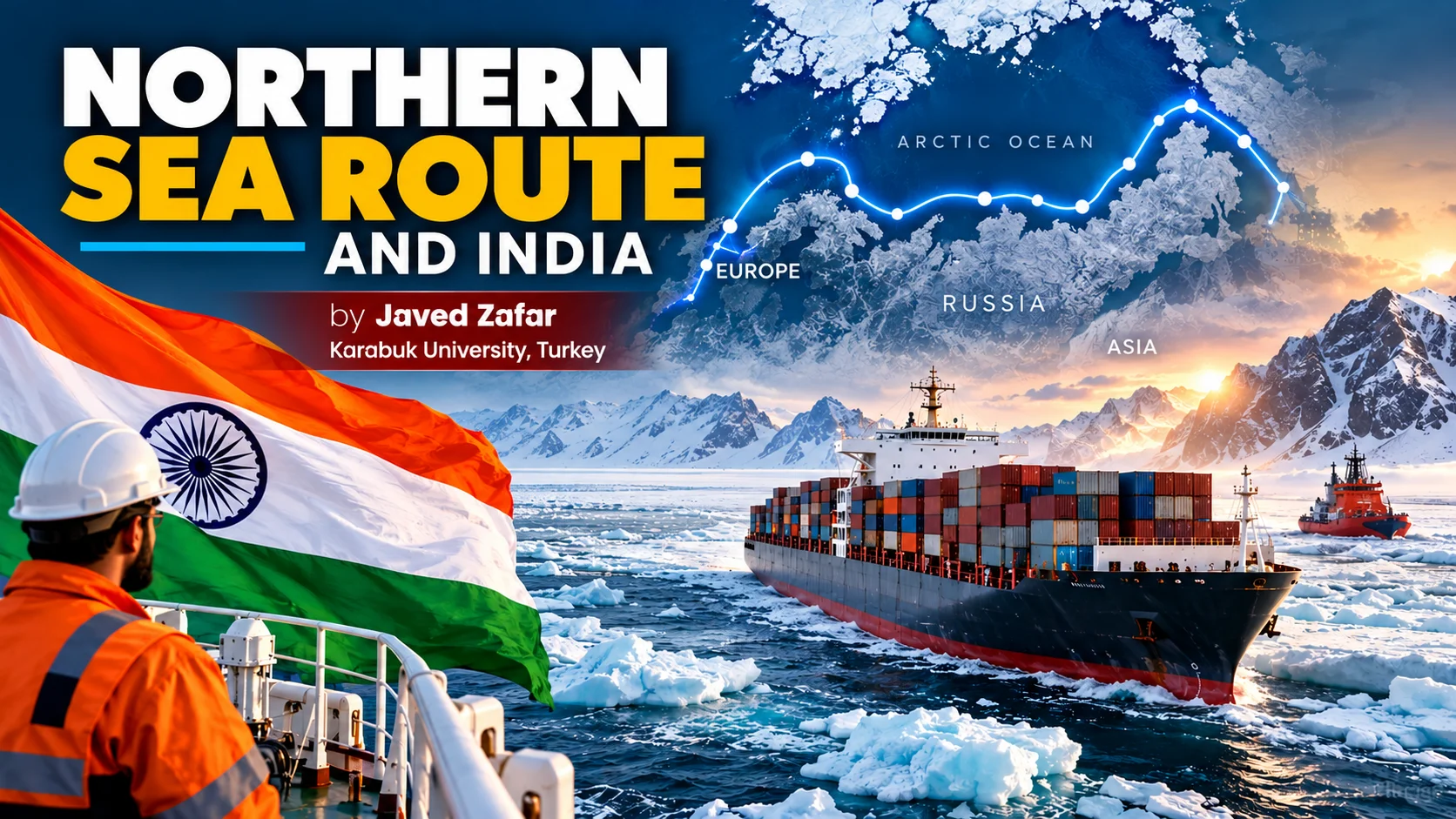
In this situation, the development of Russia’s Northern Sea Route (NSR) may have important geopolitical and economic implications. The NSR runs along Russia’s Arctic coast and offers a sea link between the North Atlantic and the North Pacific via the Arctic Ocean. This route is being promoted by Russian investment in ports, icebreakers, navigation systems, energy infrastructure and Arctic settlements. The NSR has not yet become a full substitute for well-established maritime routes such as the Suez Canal. Navigation is still influenced by ice conditions, weather, infrastructure limitations, the requirements of the vessels, seasonal variations and the relatively high costs of operating in the Arctic. Yet, advances in technology and changes in the Arctic environment are providing opportunities for increased seasonal and commercial use of the route. It must therefore be seen not as an immediate replacement for the Suez route, but as an evolving alternative element of the Eurasian maritime transport system.
The importance of the Arctic economy does not end with shipping. It has considerable natural resources such as oil and natural gas, nickel, copper, cobalt, graphite, iron ore and rare earth elements. These resources are becoming more important as the world moves towards renewable energy, electric mobility, advanced manufacturing and digital technologies. Russia, Canada, Norway, Greenland, the United States and the Nordic countries all have a great deal of resource potential in the Arctic and sub-Arctic areas. There are also possibilities in the fields of fishing, tourism, renewable energy, hydrogen production, telecommunications, satellite services, logistics and infrastructure development. As a result, the Arctic is slowly turning from a rather isolated resource frontier into a multifaceted economic area where resources, transport, energy, technology and geopolitics come together.
The NSR also has effects on the general pattern of connectivity across Eurasia. While European and Asian countries have increasingly looked into the economic possibilities of Arctic shipping, the extent of their involvement varies depending on their commercial interests, political relationships, technological abilities and regulatory factors. For Russia, the NSR gives the opportunity to connect its Arctic regions with the Russian Far East and to reinforce the links between its European and Asian economic areas. For Asian economies, it means potential access to a northern sea route which connects Asian manufacturing centres with European markets. For China as well, the Arctic is part of its wider aim to diversify its international transport and energy networks. The fact that this is happening indicates that the Arctic should increasingly be considered as part of the broader Eurasian transport and geopolitical system, not as a separate polar region.
India and the Arctic
In this evolving geographical situation the Arctic is becoming more important to India. The country is confronted by a complicated mix of energy, trade, maritime and geopolitical problems; its economic growth is largely dependent on having secure access to energy and international markets, and because of its geographical location it links the Indian Ocean with the wider Eurasian system. It has for this reason created a more multidimensional Arctic policy which incorporates scientific research, environmental concerns, energy security, economic cooperation, maritime connectivity and strategic interests.
India has had a long-standing historical connection with the Arctic. It was one of the signatories of the Svalbard Treaty in 1920, thus creating an early legal link with the Arctic area. Nevertheless, India’s involvement in scientific research did not begin until much later. The country carried out its first scientific expedition to the Arctic in 2007 and set up the Himadri research station at Ny-Ålesund in Svalbard in 2008. Indian researchers have since carried out studies in the fields of atmospheric science, glaciology, marine ecosystems, biodiversity, geology and climate change. In 2014 India founded the IndARC observatory and in 2016 the Gruvebadet atmospheric laboratory. These actions show that India’s engagement in the Arctic initially took place mainly within the context of scientific and environmental research.
When India became an observer of the Arctic Council in 2013, its involvement became more important since this gave India a formal institutional basis from which to take part in discussions on Arctic science and the environment. India’s interest in Arctic climate processes is also linked to its own environmental and economic security, as changes in the Arctic can affect atmospheric and oceanic systems outside the polar area, such as those related to the Asian climate and the Indian monsoon. As a result, Indian research into the Arctic is not merely concerned with polar science; it has consequences for agriculture, water resources, climate adaptation and long-term economic planning in India.
India’s interests in the Arctic have since gone beyond that of scientific research. The India Arctic Policy, which was issued in 2022, shows a more comprehensive strategy covering research, environmental protection, economic development, transportation, human resources and international cooperation. It is therefore possible to see the development of India’s engagement in the Arctic as a shift from a focus on scientific activity to one of multidimensional strategic involvement.
Arctic Resources and India’s Energy Security
Energy security is one of the key aspects of India’s interests in the Arctic. Since India is a large energy-user and still relies on international markets for a significant part of its needs in respect of hydrocarbons, the Arctic region of Russia has considerable oil and natural gas resources and the large-scale development of LNG in that part of Russia has opened up opportunities for international energy trade. It follows that collaboration with Russia in the Arctic could potentially help to achieve India’s long-term energy diversification.
India and Russia have already talked about the possibility of using the NSR for the transport of energy. In 2019 the Indian Ministry of Petroleum and Natural Gas clearly mentioned the possibility of using the Arctic route for transporting Russian crude oil and LNG, on the grounds that it might potentially lead to a reduction in both the costs and the time needed for the transport of certain energy supplies. The statement issued at the 2021 India–Russia summit then referred to the possible use of the NSR for the purpose of supplying energy and stated India’s interest in working with Russia on the route.
This establishes an important geographical link between Arctic energy resources and Indian energy markets. Instead of seeing the Arctic merely as a remote polar area, India can regard it as part of a broader Eurasian energy network that connects the resource-producing regions of Russia with the Asian consumption centres.
Northern Sea Route and India’s Maritime Strategy
The NSR is important for India since it can act as an extra element of its wider maritime connectivity strategy. International trade for India is closely linked to the Indian Ocean and to the sea routes that connect Asia, the Middle East, Africa and Europe. Although the Suez Canal route is still of great significance, disruptions to maritime transport have shown how valuable it is to have a diversified range of routes. The NSR could thus offer India an extra northern link to European markets, especially when used in conjunction with Russian ports and their railways and inland transport networks.
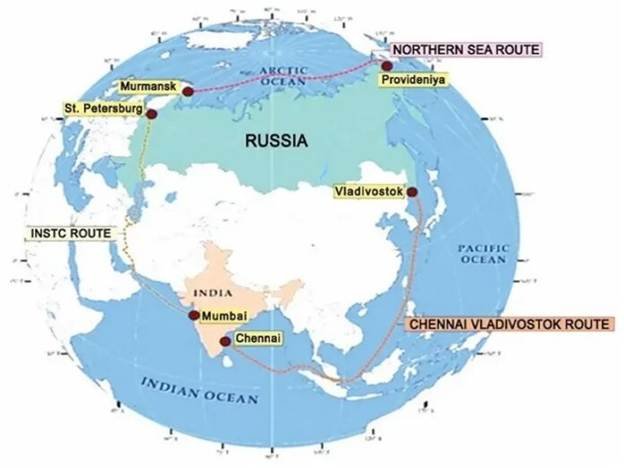
India’s approach should not be seen as an effort to replace either the Indian Ocean or the Suez Canal; rather, the NSR could act as a complement to India’s current maritime corridors. The country is at the same time developing or supporting a number of connectivity projects, such as the International North–South Transport Corridor (INSTC), the Chennai–Vladivostok/Eastern Maritime Corridor and the Northern Sea Route. In this respect, India’s strategy is becoming more focused on creating a network of alternative corridors rather than depending on a single transport route.
The India–Russia relationship offers an important institutional foundation for this strategy. In 2023 the two countries looked into the possibility of making use of the NSR and the Eastern Maritime Corridor and decided to work together on the training of Indian seafarers for operations in polar and Arctic areas. India has also shown an interest in setting up a partnership relating to the NSR. More recently, India and Russia have still identified the NSR, the Chennai–Vladivostok corridor and the INSTC as key components of bilateral connectivity. The two nations have also supported cooperation between Russia and India in the area of shipping via the NSR and have agreed to set up a joint working mechanism for cooperation concerning the NSR.
The fact that this development is of strategic importance lies in the way it links together three areas, namely the Indian Ocean, the Russian Far East and the Arctic. The maritime route from Chennai to Vladivostok offers a southern link by sea between India and Russia, and the NSR allows Russia to extend its transport network westwards over the Arctic. Thus, the two corridors could result in the establishment of a wider India–Russia–Eurasia connectivity system.
India, Russia and the Russian Far East
India’s interest in the NSR must be seen in the context of its increasing involvement with the Russian Far East, since Vladivostok forms an important geographical link between the Indian Ocean and Russia’s Pacific territories. In order to enhance its economic ties with the far eastern regions of Russia, India has put forward its Act Far East Policy, with a focus on areas such as energy, mining, infrastructure, maritime transport and human resources.
This creates a potential strategic chain:
India → Indian Ocean → Chennai → Vladivostok → Russian Far East → Northern Sea Route → Arctic → European markets
India could thus gain better access to Russian resources while at the same time giving Russia an extra economic partner in Asia for the development of its eastern and Arctic areas. The economic relationship between India and Russia has consequently taken on a geographical aspect which goes beyond traditional bilateral trade and involves the development of interconnected Eurasian corridors.
India and Russia have likewise determined to cooperate in the Arctic and Far Eastern areas, covering sectors such as energy, mining, maritime transport, manpower and other economic activities. A bilateral programme for cooperation in Russia’s Far East for the period 2024 to 2029 serves as the basis for expanding this kind of engagement.
Strategic Opportunities for India
From India’s point of view in terms of strategy and geography, the NSR could offer a number of possible advantages. It could help to diversify trade routes and thus reduce the excessive reliance on a small number of maritime corridors. It could also improve India’s energy security by enabling access to oil and gas resources in the Russian Arctic. Furthermore, it would open up opportunities for Indian firms in the areas of shipping, logistics, shipbuilding, port services, engineering and Arctic infrastructure. It would also allow India to acquire experience in polar navigation, ice-class shipping and Arctic maritime operations. Lastly, greater involvement might strengthen India’s economic and strategic ties with Russia and provide extra connections to European and Eurasian markets.
Arctic maritime expertise is already being incorporated into the cooperation between India and Russia. In 2025 the two countries stressed their cooperation relating to the NSR and reached an agreement on a memorandum regarding the training of specialists for vessels operating in polar waters. India has likewise shown an interest in developing cooperation in the fields of shipbuilding and maritime logistics.
Limitations and Challenges
A significant recent development indicates that India’s interest in the Northern Sea Route is moving from strategic planning toward practical maritime engagement. In August 2026, S. Venkatesapathy, Joint Secretary in India’s Ministry of Ports, Shipping and Waterways, stated at the Arctic–Regions Forum in Arkhangelsk that India plans to operate its first pilot vessel through the Northern Sea Route in 2027. He emphasized that India sees substantial possibilities not only in the Eastern Maritime Corridor (EMC), connecting Chennai and Vladivostok, but also in extending this connectivity toward the NSR. This announcement represents an important development in India’s Arctic strategy because it indicates a transition from viewing the NSR primarily as a potential strategic and economic corridor to testing its practical commercial feasibility.
The proposed 2027 voyage also has significance in relation to India’s energy security and bilateral trade with Russia. India and Russia have established an ambitious bilateral trade target of US$100 billion by 2030, while energy remains a major component of bilateral economic relations. The NSR could provide an additional transportation option for Russian energy and other commodities moving toward Asian markets, while potentially creating a northern maritime connection for Indian exports toward Europe. Consequently, the NSR has the potential to become part of a larger India–Russia economic network linking energy resources, maritime transportation and Eurasian markets.
The NSR’s potential economic advantage is also attracting greater attention because of disruptions affecting traditional maritime routes. Recent instability around the Red Sea and the Suez Canal has highlighted the vulnerability of highly concentrated global shipping networks. The NSR could offer a northern alternative for selected India–Europe trade flows. Reports in 2026 have suggested that the Arctic route can reduce the distance to some European destinations by up to approximately 40 percent and potentially reduce transit time by around two weeks compared with traditional Suez routes, although such figures vary according to the origin, destination, season, vessel and navigation conditions and should not be treated as universal savings.