Beyond tariffs: India and New Zealand need a blue-security compact

Janvi Singhi and Dr. Simran Keshwani
New Zealand has progressed further with its Free Trade Agreement (FTA) with India, as its Parliament passed the necessary legislation on September 16 and the legislation was then granted Royal Assent on September 17. This development comes along with the initiation of the new phase of bilateral ties between India and New Zealand, as after years of being friendly ties, they have agreed to establish a Strategic Partnership, with a Roadmap leading to 2030. In April 2026, the FTA was signed in New Delhi, provides duty-free access for 100 per cent of Indian exports to New Zealand once it enters into force and includes provisions on services, mobility and investment.
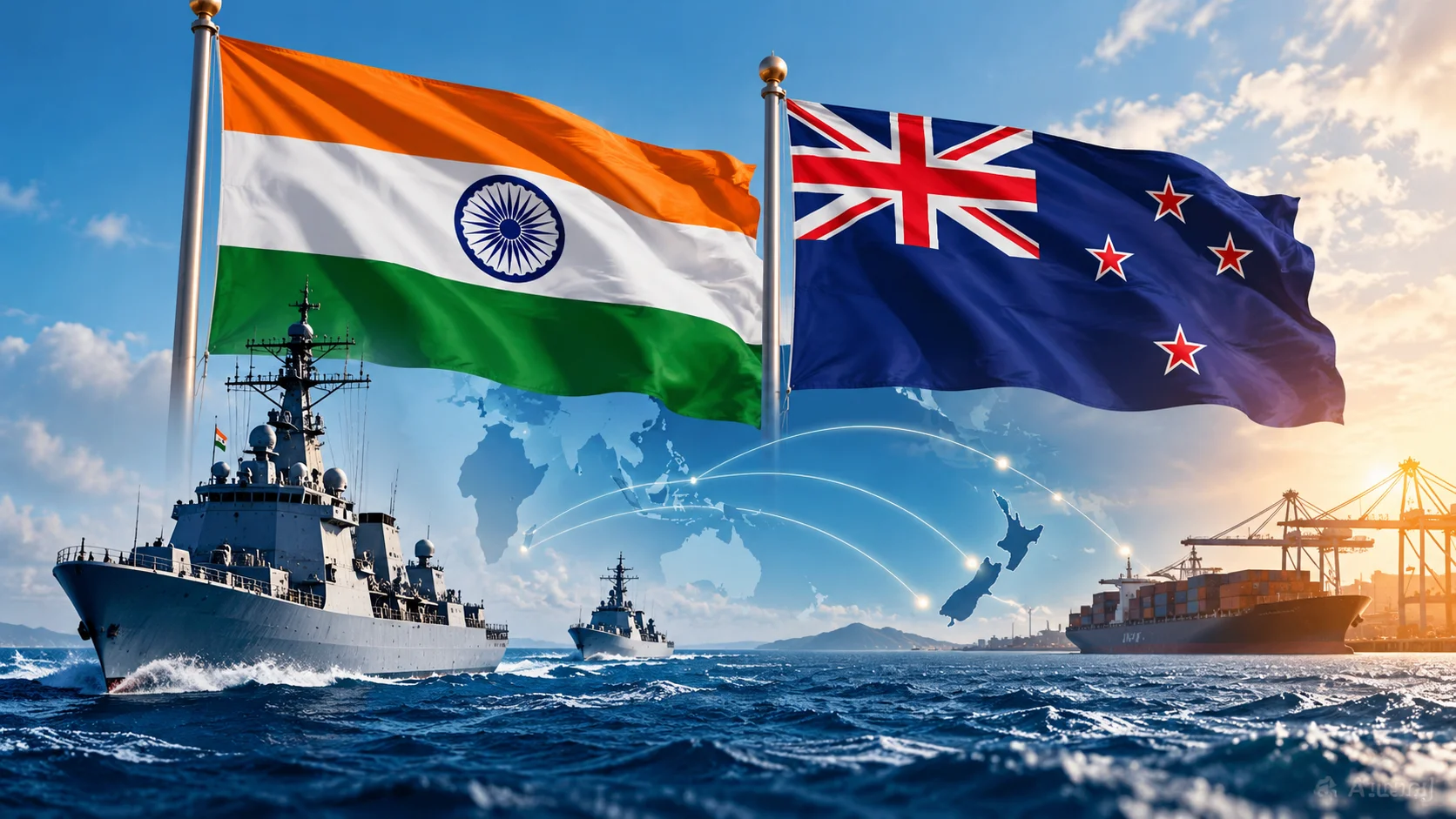
Both have simultaneously been developing two partnerships this year. One of those is economic, as they have struck a free trade agreement that permits Indian goods to enter New Zealand and offers additional opportunities for investments, mobility of people and services. The other partnership is strategic and includes areas such as maritime security and naval collaboration.
New Delhi should combine the two partnerships due to the fact that India considers Wellington as a useful ally in the Pacific region, because it possesses reputable institutions and experience working in the Pacific and focuses on ensuring compliance with international norms. This would not require an alliance, a new grouping or an attempt to draw New Zealand into India’s strategic alignments. It would mean turning commitments that already exist into an operating architecture.
The basis of the relationship is very robust. The India-New Zealand Strategic Partnership Roadmap highlights maritime cooperation as a component of the security and defence links. This includes execution of the Maritime Cooperation Arrangement, work on hydrography and nautical charts, mutual logistics support, joint maritime exercises and an annual Maritime Security Dialogue.
Operational cooperation has already started. New Zealand took command of the Combined Task Force 150 in 2025, having Indian naval personnel participating in its work. HMNZS Te Kaha and INS Tarkash conducted a passage exercise in the Gulf of Aden, which involved tactical maneuvers, communications drills, cross-deck activities and personnel exchanges. India should build the next phase around four areas.
Firstly, India-NZ already identified important aspects of cooperation that will include hydrography and nautical cartography. This might sound too complicated, even highly technical, but these aspects are critical to every maritime power. If one had reliable oceanic information, one could ensure safe navigation and port development, react in case of natural disasters, conduct naval operations, and deal with maritime resources. Such a programme could incorporate training, exchange of data and joint capacity building activities of interested countries of the Pacific region.
Secondly, functional interoperability. India does not require New Zealand to disclose all aspects of its strategic interests. It is sufficient if the two navies become capable of working together whenever their objectives align. More sailing drills, staff exchanges, joint port calls, logistic coordination, and SAR training would create understanding without establishing legal commitments.
This is important as the Indian Ocean and the Pacific cease to be independent strategic theaters. There are many links between shipping routes, underwater facilities, cross-border criminality, and supply chain disruption. New Zealand’s economic interests in this region will grow with its ability to understand and protect maritime routes connecting these two oceans.
Thirdly, it is essential for the partnership to prioritize maritime governance. An example of this is illegal fishing which affects many Pacific countries, wherein illegal fishing is not only a security issue but also affects government revenues, food security, and control over the exclusive economic zones. While one partner can provide surveillance, training, digital tools, and capacity building, another partner can provide a range of relevant experience obtained in Pacific countries as well as useful contacts in the region.
This is similar to search and rescue and humanitarian aid as well as clean-up measures, and this cooperation is beneficial because it helps develop the required relationship based on security as well as many other benefits generated by the activity.
Fourthly, India must link maritime security with the economics of the FTA. With more trade, there is more reliance on ports, shipping, logistics, seamen, and reliable sea routes. The existing bilateral roadmap proposes cooperation between Indian maritime authorities and Maritime New Zealand, including assessment of maritime certificate qualifications of sailors. The agenda can further be expanded to include matters of port resilience and maritime skills.
This is the place where FTA becomes interesting for India from a strategic standpoint. Trade agreements are usually evaluated by tariffs and volume. But the viability of trade is more and more reliant on the infrastructure and security conditions transporting goods.
Hence, the engagement between India and New Zealand provides New Delhi with the prospect of introducing a new paradigm of Indo-Pacific statecraft – one based on maritime capacity that supports economic or economic integration rather than a situation whereby economics and security coexist as two parallel processes.
This is also connected to a more strategic interest on the part of India. New Delhi has been trying for years to promote its Indo-Pacific vision as one based on cooperation rather than closed military alliances, so creating a blue security partnership with New Zealand will help turn this into reality. The partnership could help provide navigation and vessel safety data, enhanced maritime governance, as well as making two states’ maritime systems more resilient.
In this context, the FTA should be viewed as a tool that surpasses mere economic purpose. It can serve as the economic basis for an overarching maritime relationship from the Indian Ocean to the Pacific. The access to the market in New Zealand has improved for India. The greater opportunity lies in ensuring safe movement of maritime traffic supporting trade through channels developed by India itself.
Janvi Singhi is a Gold Medalist in International Relations and holds a Master’s degree in Political Science from Hyderabad. She is an independent researcher and has authored research papers and opinion articles on Foreign Policy, geo-economics and Strategic Affairs.
Dr. Simran Keshwani is a Sydney-based political economist specialising in India’s clean-energy transition, industrial strategy and Indo-Pacific economic security. She is the author of four forthcoming books on India’s rise & statecraft and writes regularly on energy, geoeconomics and regional security.