Iran’s Neo Siyasatnama

By – Prayant Praved
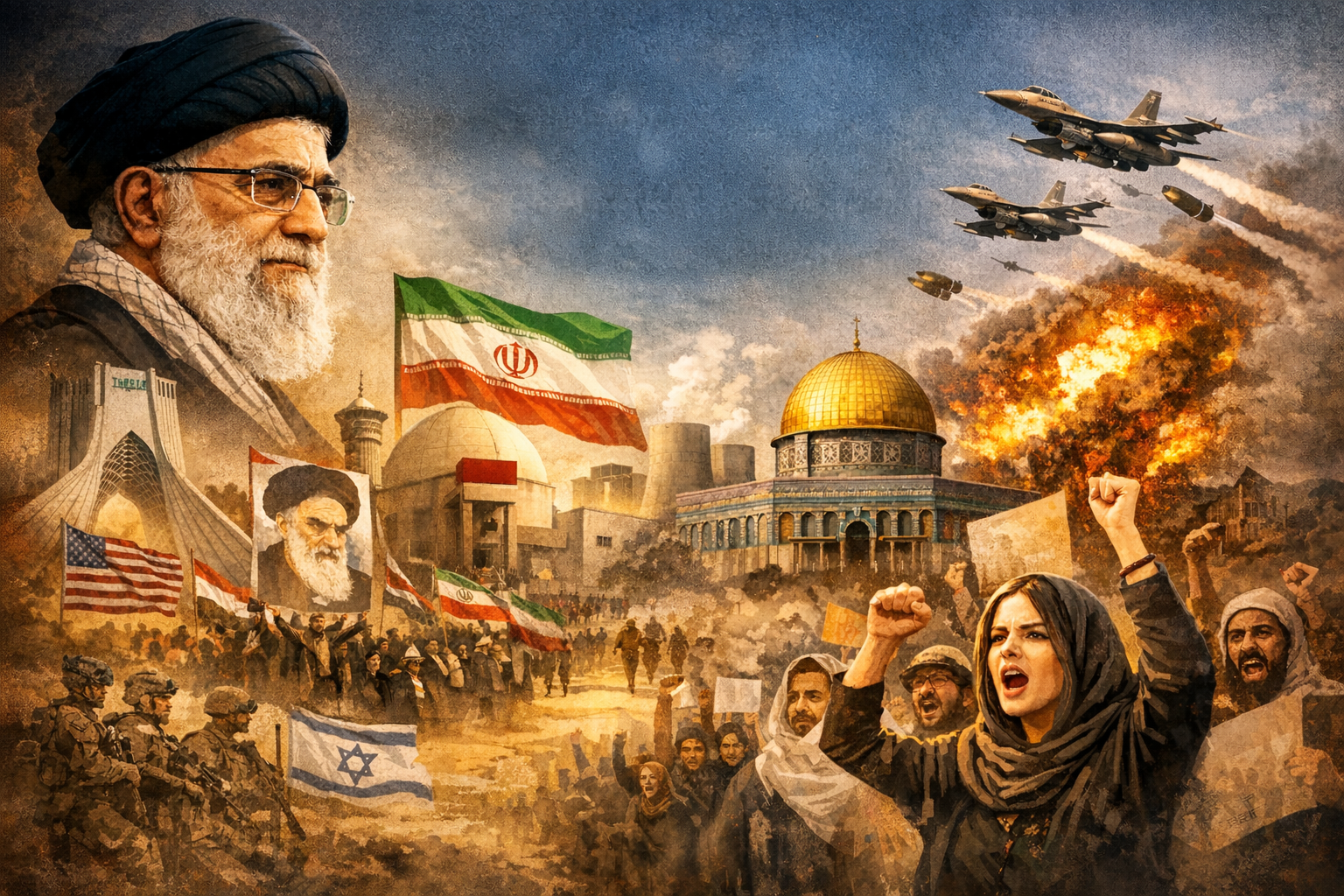
It was in the 11th century that Nizam-al-Mulk Tousi, the prime minister of the Seljuk Empire, wrote Siyasatnama, the seminal work on statecraft and the art of governance. The contemporary protest in Iran calls for an analysis of the strategy that the Iranian government has followed since the 1979 revolution. There were three great revolutions of the 20th century—the Russian, the Chinese, and the Iranian—and ironically, all these three regions are now anti-US. Iran is strategically situated at the crossroads of Central Asia, the Caucasus, and the Gulf. It embarked as the land of an ancient civilization and is currently home to 90 million people. It is an ambitious regional power that sustains its influence and expands its security vis-à-vis other external players in West Asia. However, its influence is challenged with the Israeli attack on its military leadership and targeting of nuclear facilities in June 2025. But such aggression proves inconclusive, as it failed to topple the Islamic Republic. Six months after this aggression, Iran is facing a critical protest.
The Basis for the 1979 Revolution
In the 19th century, Britain wanted to keep Iran-Afghanistan as a semi-independent state to buffer against the USSR. Imperialistic power deeply penetrated Iran. The French had strong command over Iran’s economy. It was an imperialist force that designed a plan to distribute Iranian territory between Russia and Britain. This plan failed because of the Bolshevik revolution of the USSR in 1917. During World War I, Iran went through a severe famine, and it lost a large part of its northern portion to Russia, which is now Azerbaijan, Armenia, Turkmenistan, Uzbekistan, and Georgia. Britain separated Afghanistan from Iran completely and also took over the Bahrain region. These developments created a sentiment that the imperial power wanted to abuse Iran.
The three Allied powers invaded Iran during World War II, using its food to fuel Stalin’s army. The USSR occupied northern Iran as the war ended, but the Red Army vacated the territory in 1946 under pressure from the US. Such bullying and insulting behavior of imperial forces compelled it to sow the seed of its neo strategy.
Iranian Grand Strategy
The charged Iranian sentiment pushed for the Nationalist movement of 1950 in the region. The movement was against imperialist forces, particularly Britain, with the stated goal of Iran controlling its own oil resources. Mohammed Mussader, prime minister of Iran in the 1950s, claimed sovereignty over Iran’s national assets. This move had simmering opposition within Iran because of the fear factor that anti-westernism might lead to communism. But the military coup in 1953, supported by its monarchy, Britain, and the US, threw out the nationalist prime minister, after which Iran was under the influence of western power, particularly the United States, until the 1979 revolution.
The ideology of the Iranian revolution revolved around Islam as salvation, creating a perfect state way of communism. The leaders of the revolution, the secular democratic leader, and the religious element aspired for Iran’s future government to be based on two principles: Islamic and democratic. While signing the agreement with the leaders of the revolution, the Supreme Leader of the Revolution, Ayatollah Khomeini, wrote in the margin that it would be independent. It implied two things in Iranian history. First, Islam alone will provide Iran independence, and second, the Iranian revolution will provide Iran genuine independence. While landing in Tehran from Paris, after the Iranian revolution, he commented on the press brief that all decisions will be made in Iran. The importance of independence can easily be read through the minds of revolutionaries. Mohammed Javad Zarif, ex-foreign minister of Iran, had once said that in the past 200 years of its history, the Islamic Republic is the only government that has given Iran genuine independence. Revolutionaries didn’t see Iran as an independent country between 1953 and 1979. The Revolution saw the imperialist as their enemy who wanted to subjugate them. During the revolution, Americans were made hostages, and the American Embassy in Iran was forced to shut down. It urged the US to leave the Middle East. Iran looks at the US as a force that wants to topple its regime and take over its oil resources.
In the 8-year war between Iran and Iraq in 1980, Iranians viewed Iraq as a puppet of the US that had invaded their territory with American support. This war is seen as an extension of the American project to reverse the Iranian revolution. Iraq under the leadership of Saddam Hussein was supported by the Arab State, the USSR, European powers, and the United States. This episode gave a lesson of isolation to Iran in the region. Iraq used chemical weapons in the war, and there was no condemnation. This message is ingrained in the leaders of Iran: that their country is continuously under attack and it needs to protect itself. Therefore, it created the Iranian Revolutionary Guard Corps in 1979. This 8-year war brought a lesson for the Islamic Republic to defend itself from foreign forces, not only at its border but also deep within the Arab world. Therefore, Hezbollah in Lebanon is not an imperialistic project for Iran to conquer the territory and menace Israel but to develop proxies in the Arab world to protect its independence. The US invasion of Iraq in 2003 was faced by opposition from Iraqi militias trained by Iran so that the Americans don’t think of Iran as their next expedition.
Price Paid for Sovereignty
The exaggerated pursuit of independence has shaped the domestic politics, economy, society, and thinking of leaders and military forces in Iran. It has faced the economic sanction of the West, the unilateral withdrawal of the US from the JCPOA deal (2015), the curtailed movement of its oil ship, etc., to maintain its sovereignty. Israel’s recent bombing of Iran, the depreciation of its currency, and the protests against the authoritarian regime are ongoing consequences of its pursuit of independence.
After the October 7 incident and the Gaza war, Iran’s line of defense in the Arab world collapsed. Israel took on the war against Hezbollah, leading to the collapse of militant forces and subsequently Syria in 2024. This allowed Israel to take war to Iran directly. And now, Iran is facing confrontation at its border and inside. According to various strategic experts, the current protest is a part of the West’s game against Iran’s Grand Strategy. The masses are showing their anguish for these 40 years of war for sustenance of independence through protest and anger against hijab rule.
As Charles Tilly, in his book, Coercion, Capital, and European States, famously quoted that war makes states and states make war, likewise Iran is a state created by war with the US and not the nation created on the lines of Islam. Islam itself has two Shariah laws—the Sunni and the Shia, which are not universal. War with the US is not an Islamic crusade. It is waged in the name of Islam, but it is a war that comes from the persistent pursuit of independence at all costs.
Prayant Praved is an intern at IDDF Research Foundation.