Strategic & Maritime Dimensions of India–Oman Relations

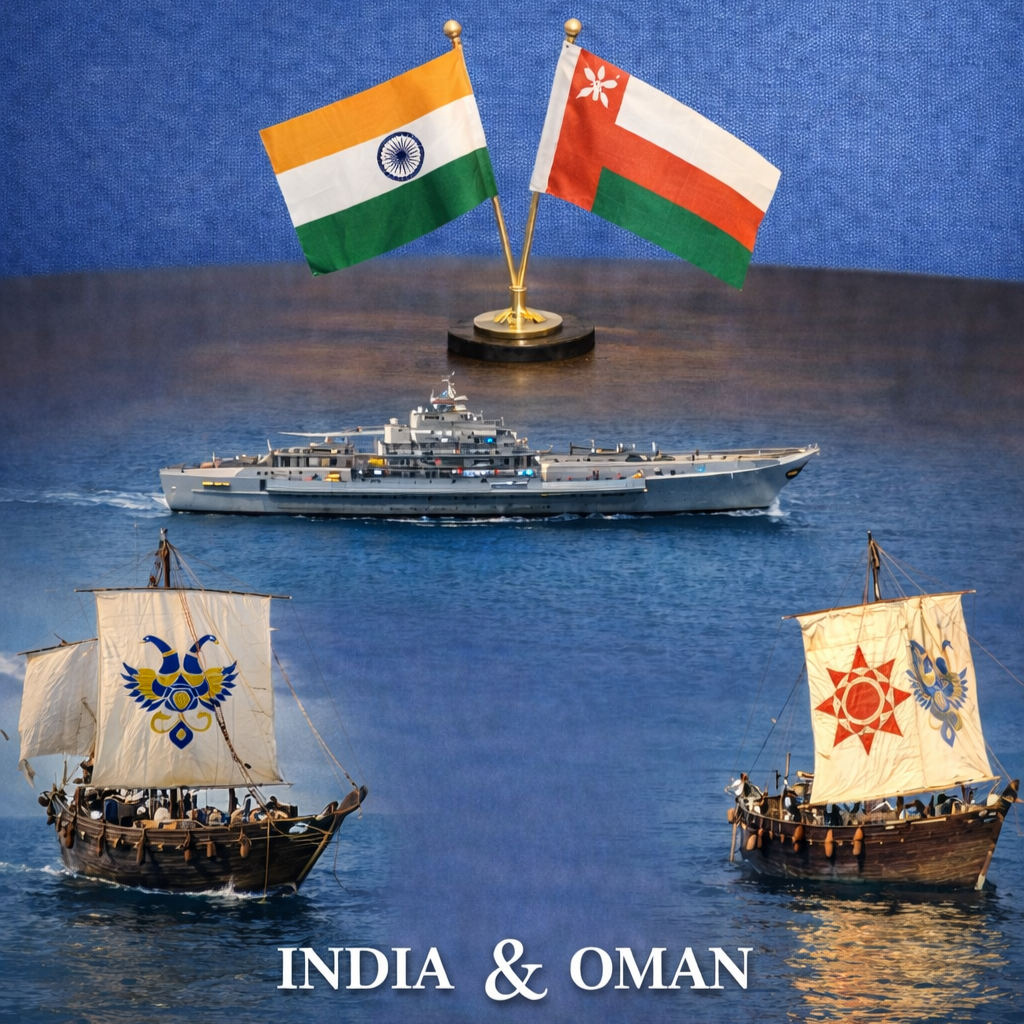
Our Research Intern, Neha Chauhan, engaged in detailed discussions with Capt. K. S. Vikramaditya (Senior Fellow, National Maritime Foundation) and Anum Khan (Associate Fellow, National Maritime Foundation) on the strategic and maritime dimensions of India–Oman relations.
Key Question:
What role does India–Oman strategic and maritime cooperation play in ensuring stability and security in the Indian Ocean Region and the Western Indian Ocean littoral?
(Content follows exactly as provided—no change)
Insights by Capt. K. S. Vikramaditya (Senior Fellow, NMF)
Geography is essential and plays a preeminent role in geopolitics, geoeconomics, and geostrategy. Oman, overseeing the Strait of Hormuz (and the entry/exit to the Persian Gulf)—through which passes a large proportion of the world’s energy resources— has a very strategic location.
What makes Oman’s geography particularly strategic for India is the fact that traditionally, West Asia has been the major source of oil and gas for us. Russian energy is a recent phenomenon.
Oman borders countries that are crucial to us, viz., the UAE and Saudi Arabia, and for that matter, even Yemen, which, once again because of its strategic location overlooking the Bab-al-Mandap and the Gulf of Aden, is important for us from a security perspective.
Oman also lies near Iran, particularly Chabahar, in which India has a major economic and geostrategic stake, especially insofar as access to Central Asia and the utilization/optimization of the INSTC are concerned. Chabahar is also important in terms of access to Afghanistan, circumventing Pakistan.
Let us shift our focus to another very important element of geography—the Port of Duqm. There, India has received substantial concessions. When viewed in the context of a mutual logistics agreement concluded in 2023, Duqm becomes very strategic for India. It lies in close proximity to Gwadar and Pasni and the Makran coast as a whole. It overlooks the Gulf of Oman. It provides sustained forward presence to the Indian Navy and will in the coming days become a very important cog in the Navy’s strategy of maintaining forward presence throughout the IOR in the form of mission-based deployments. The Navy has been maintaining a consistent presence in this region in any case—Duqm will ease the maintenance, logistics, and sustenance element of this deployment considerably.
The Indian Navy has been undertaking ship visits to Muscat regularly and now to Duqm too. Salalah is another port that the Navy has been using for a considerable period, especially for sustaining presence in the Gulf of Aden for anti-piracy missions (unbroken presence since 2008). Indian naval presence in this region over a period of time has become normalized. This is a very important step in India being perceived as a first responder, the preferred security partner, and most importantly, a force for good in the region.
All of the above make it clear as to how important Oman is wrt India’s energy security and the security of energy (overlooking Indian energy SLOCs), both from the perspective of the Persian Gulf and also the Red Sea.
It would make tremendous geoeconomic sense to put in place a fast and secure energy corridor to India, with Duqm as one of its nodes.
An analysis of India-China trade reveals India’s overwhelming dependence on the latter for organic chemicals. Oman, the UAE, and Saudi Arabia are reasonably big players in this domain. Organic chemicals for fertilizers and perhaps even precursors for medicinal use are avenues that can be explored for further maritime cooperation.
The IMEC in its current form of conceptualization encompasses India, the UAE, Saudi Arabia, Jordan, Israel, and some European countries thereon. This configuration mandates the corridor passing through the Strait of Hormuz, which is an inherently unstable waterway. Inclusion of Oman in the IMEC would obviate this disadvantage and make the IMEC more robust from a security perspective.
India, especially the Indian Navy, has been training officers and men in the Omani defense forces for a considerable period. We also undertake bilateral defense exercises that are consistently growing in scope and scale. It needs to be borne in mind that such exercises require a lot of mutual trust and, in fact, may be considered the most evolved form of diplomacy. This obviously becomes a foundational building block for prospective strategic endeavors.
India and Oman have recently concluded an MoU on maritime heritage and museums. This aligns closely with India’s project MAUSAM and may be leveraged for further maritime interaction. INSV Kaundinya sailing from Porbandar (set sail on 29 Dec) for Muscat is an important event in this regard.
Insights from Anum Khan (Associate Fellow, NMF)
The following section is based on original written inputs received from Anum Khan (Associate Fellow, National Maritime Foundation) on the strategic and maritime dimensions of India–Oman relations.
(Content follows exactly as provided—no change)
The security seascape across the Indian Ocean has evolved dramatically in recent years, largely shaped by political upheavals within its littoral states. The Western Indian Ocean, in particular, is witnessing a convergence of complex challenges driven by a sharp rise in non-traditional maritime security threats. Oman’s immediate neighborhood—especially the waters of the Gulf of Oman—has become increasingly constrained by geopolitics, owing to escalating tensions between Iran and the United States, the maritime spillover of the Houthi-led crisis that is fueling illicit maritime activities across the sub-region, and the seasonal resurgence of Somali piracy, whose nature and operational patterns have significantly transformed over time.
India’s maritime cooperation has been driven by the imperative of securing both its immediate and extended maritime neighborhood. Oman’s relative stability within an otherwise volatile maritime region, combined with its long-standing national security policy of partisan non-intervention, positions it as a conduit for diplomatic dialogue and an anchor of stability in the Western Indian Ocean. Oman’s Port of Salalah has traditionally served as a critical node of maritime connectivity for India, functioning as a major transshipment hub and logistics facilitation point, and has been ranked as the second most efficient container port globally for three consecutive years (2021–2023) by the Container Port Performance Index (CPPI).
India’s access to the Port of Duqm, granted in 2018, has further expanded its strategic maritime reach and offers a viable alternative to the relatively high-cost ports of the Persian Gulf. However, India’s maritime engagement extends beyond port access alone. Effective maritime threat mitigation requires littoral states to maintain a comprehensive and real-time maritime picture—an objective that forms a shared agenda between India and Oman. In this regard, institutions such as the Maritime Security Centre in Muscat, India’s Information Fusion Centre–Indian Ocean Region (IFC-IOR), and the Information Management and Analysis Centre (IMAC) play a crucial role in enhancing Maritime Situational Awareness (MSA).
Beyond ports and logistics, such cooperation is essential to counter transnational organized maritime crimes prevalent in the Gulf of Aden and maritime spaces affected by the Houthi crisis. Oman’s strategic location astride the Strait of Hormuz—a critical global oil transit corridor through which nearly 30 percent of India’s daily crude oil imports pass—further underscores its importance. Amid periodic threats of disruption, Oman’s stabilizing role and long-standing regional ties offer a crucial pacifying influence.
At the regional level, the absence of a collective maritime security agenda within the Gulf Cooperation Council (GCC) makes India’s maritime outreach to Oman a potential entry point into the GCC’s evolving maritime outlook. Additionally, India’s current chairmanship of the Indian Ocean Rim Association (IORA), of which Oman is a founding member, provides an important multilateral platform—particularly under the Safety and Security pillar—to jointly address country- and region-specific maritime challenges.
Finally, sustainability is emerging as a shared priority. In the post-Paris Agreement era, both countries are actively pursuing green maritime initiatives. India’s Harit Sagar Green Ports Guidelines, National Green Hydrogen Mission, and the National Centre of Excellence for Green Ports and Shipping align well with Oman’s development of its first eco-friendly ship recycling facility at Khatmat Malakha in North Batinah. If green maritime solutions are a mutual objective, sustainability should be institutionalized as a combined pillar of India–Omani maritime cooperation. Recent discussions on Oman’s integration into the India–Middle East–Europe Economic Corridor (IMEC), as well as the India–Oman Maritime Heritage Memorandum of Understanding, further add strategic and historical depth to this evolving partnership.