Event Report: Global Power Shifts and the Middle East — Reflections from the Doha Forum

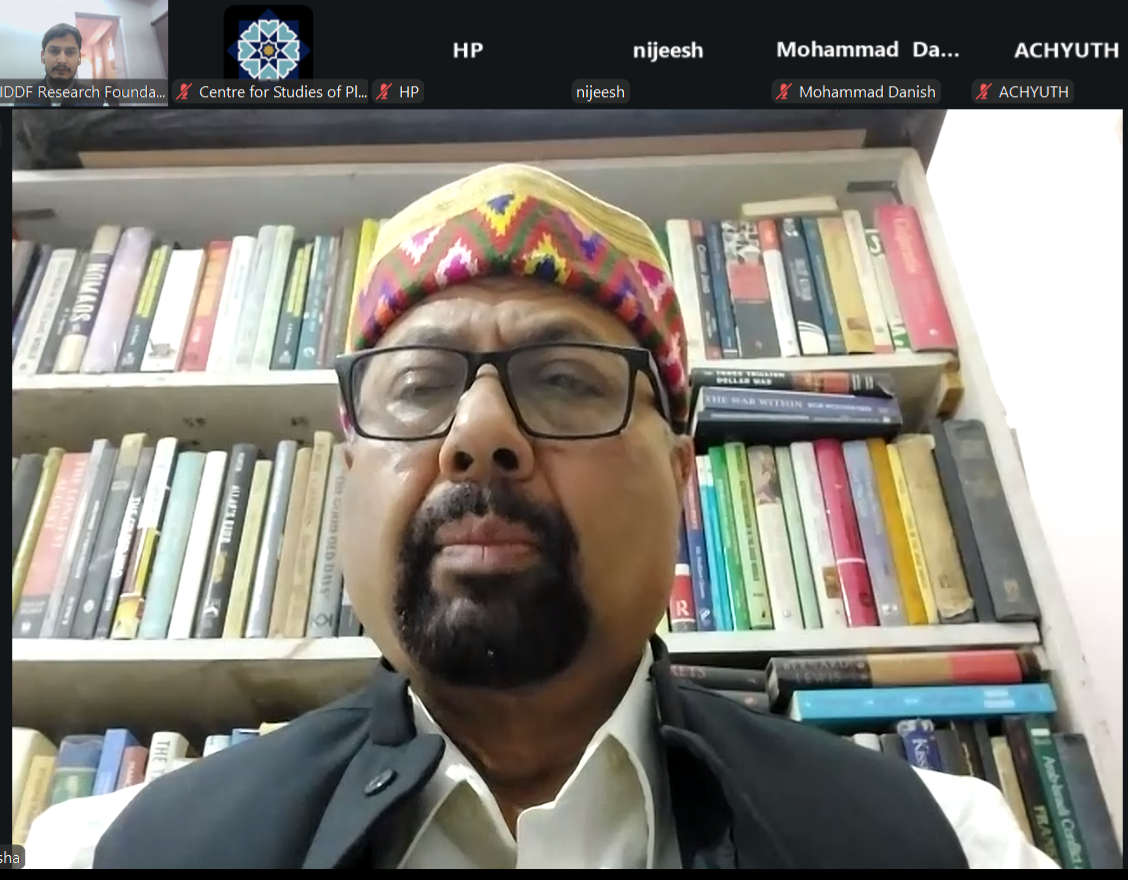
The IDDF Research Foundation organised a Zoom-based academic talk on Friday, 26 December 2025, at 4:00 PM (Indian Standard Time), titled “Global Power Shifts and the Middle East: Key Takeaways from the Doha Forum – How Global Policy Forums Shape International Agendas: A Scholar’s Perspective.” The session was delivered by Professor Aftab Kamal Pasha, Director, IDDF Research Foundation, and former Associate Dean, Director, and Chair of Gulf Studies at the School of International Studies, Jawaharlal Nehru University (JNU), New Delhi.
Drawing upon his direct engagement with the Doha Forum, Professor Pasha offered a nuanced scholarly assessment of contemporary global power transitions and their implications for West Asia. He described the Doha Forum as a premier international platform that convenes world leaders, policymakers, diplomats, academics, and journalists to deliberate on pressing global challenges. According to him, the forum functions as a space where “those who shape policy and those who analyse it interact in real time,” producing significant intellectual and diplomatic exchanges. A notable emphasis of the forum, particularly in its later sessions, is on mediation and conflict resolution in regions experiencing active crises.
Professor Pasha contextualised these discussions within the broader transformation of the international system since the end of the Cold War. He argued that the initial unipolar moment led by the United States was gradually undermined by strategic miscalculations in the West. Referring to the economic rise of East Asia, he observed that China’s emergence as a global economic power was enabled by Western policy choices, noting that “manufacturing moved eastward while strategic foresight remained limited.” These developments, he argued, have significantly altered global power equations.
At the Doha Forum, Professor Pasha noted, competing narratives of global order were clearly visible. While Western participants continued to emphasise the durability of a “rules-based international order,” representatives from Russia, China, India, Turkey, Iran, and other Global South countries presented empirical evidence of shifting economic, political, and diplomatic realities. He remarked that although multipolarity is “still a work in progress,” it is increasingly evident through alternative trade arrangements, resistance to unilateral sanctions, and the growing diplomatic confidence of non-Western powers.
The lecture also highlighted Qatar’s evolving role in global diplomacy. Professor Pasha described Qatar as a small state that has leveraged mediation, dialogue platforms, and soft power to play a disproportionate role in international affairs. He pointed to Qatar’s involvement in negotiations related to Gaza, Afghanistan, and Ukraine, stating that mediation has become “central to its foreign policy strategy.” At the same time, he underlined the country’s complex positioning—maintaining close security ties with the United States while enabling alternative global narratives through media platforms such as Al Jazeera.
Professor Pasha concluded with a balanced assessment of global policy forums themselves. While acknowledging their importance as spaces for dialogue and agenda-setting, he noted that such platforms also operate within political and structural constraints. Certain issues and perspectives, particularly those critical of dominant allies or domestic power structures, often remain marginal. Nevertheless, he emphasised that forums like Doha play a critical role in reflecting emerging global realities and facilitating engagement across geopolitical divides.
The talk reaffirmed IDDF Research Foundation’s commitment to advancing informed scholarly dialogue on international relations, West Asian geopolitics, and the shifting contours of global power, particularly from an Indian and Global South perspective.