INDIA & EUROPE IN A MULTIPOLAR WORLD ORDER

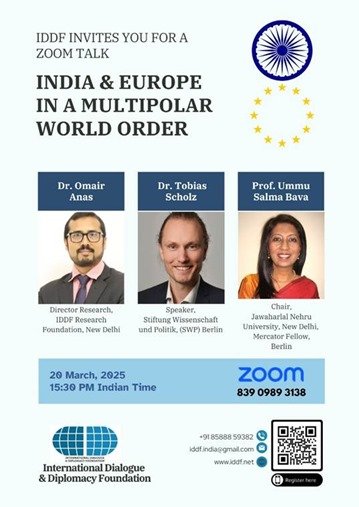
Webinar, 20 March 2025
The talk, chaired by Prof. Ummu Salma Bava and featuring speaker Tobias Scholz, moderated by the IDDF Research Foundation, focused on the evolving dynamics of European security policy and the role of India as a strategic partner in the shifting geopolitical landscape. Tobias Scholz highlighted that within the U.S., perspectives on transatlantic relations remain largely centered around the “Trump effect” and a desire to return to pre-Trump norms. However, for Europe, the idea of “building back better” is no longer viable. Biden’s election initially revived European trust in American security guarantees, but recent developments have spurred a dramatic paradigm shift in European foreign and security policy. Although the European Union
lacks full consensus due to divergent national interests, particularly from Hungary, a coalition of willing nations is pushing for a transformation of European defense and strategic thinking. Scholz emphasised the distinction between alliances and partnerships. Traditionally, European security has relied on alliances built on deep trust, with a mutual commitment to defend each other. Replicating such alliances outside the transatlantic framework is unlikely, yet partnerships with countries like India are becoming increasingly vital. India, with its regional security concerns, particularly regarding China, presents an opportunity for Europe to expand its understanding of Indo-Pacific and South Asian security dynamics. Prof. Bava added that Europe is being compelled to reimagine its security landscape, with no return to previous paradigms even after Trump. Political realisation across Europe indicates a shift toward collective action, though diverging perceptions remain. Importantly, while India and Europe do not share identical security challenges, both sides can better appreciate each other’s perspectives and collaborate on common concerns.
The growing engagement between India and Europe is evidenced by the EU’s appointment of a defense attaché in Delhi, signaling a deepening bilateral relationship. Technological collaboration, particularly in the military-industrial domain, is emerging as a promising area for cooperation. Germany, for example, has outlined strategic partnerships with India, underscoring shared interests in defense and security. The conversation concluded with reflections on Europe seeking new partnerships amid transatlantic uncertainty. Countries like India, Brazil, and South Africa have emerged as key partners in Europe’s evolving security strategy. The discussion underscored the necessity for Europe to rebuild and reposition its security architecture, with India playing a pivotal role in shaping a more robust and balanced global order. The IDDF Research Foundation expressed interest in continuing this dialogue, envisioning future engagements to explore India-Europe relations and broader international affairs.