Between Peace and Power: The Geopolitical Implications of the Armenia–Azerbaijan Peace Deal

By – Musheer Ul Hasan Ekrema
Across history, the rise and fall of empires have often hinged on control of trade and economic lifelines. Trade routes, particularly those through land, have played a crucial role in shaping power balances. In today’s world, one such route is the Zangezur Corridor, which has taken centre stage in the South Caucasus region’s trade networks. Stretching between mainland Azerbaijan and its Nakhchivan autonomous region across the southern part of Armenia along with the border with Iran, the corridor has become one of the most debated and potentially transformative projects in the region [2][3].
The Zangezur Corridor: Why It Matters:
The Zangezur Corridor’s design itself explains why this matters, the route is situated at the crossroads of the South Caucasus, linking the Caspian Sea region with Turkiye and then to Europe. It also offers a land bridge into Central Asia, an area increasingly important for both trade and energy [3][5]. For Azerbaijan, it is the long-awaited solution to the Nakhchivan region’s isolation, and to Turkiye, it means an unhindered land route to Central Asia, fueling its vision of greater pan-Turkic unity, under the guise of “Organisation of Turkic States” [5]. Meanwhile, Armenia is a bit more cautious in all this, a large number of them are worried about their sovereignty and security, but still for them, this corridor could also open doors to trade, its revenues, and badly needed infrastructure investment [6]. Beyond the local actors, global powers see the corridor as more than a road: it is a gateway into the Eurasian heartland, where economic projects are never far removed from strategic influence [6].
The Washington Treaty and the 99-Year Clause:
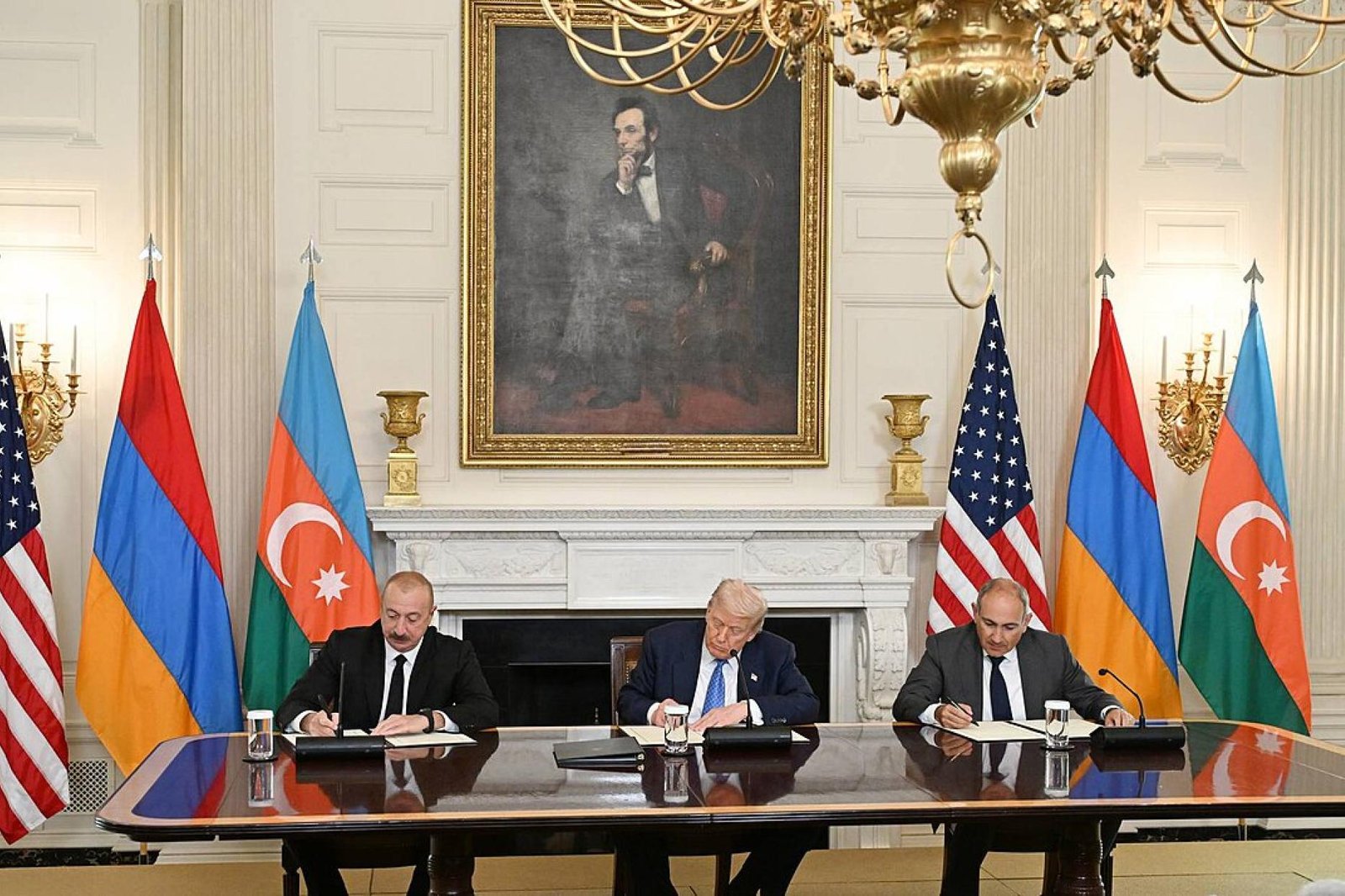
The peace deal that was brokered in Washington in 2025 under the Trump administration was framed as a breakthrough, focused on recognition of mutual borders, renunciation of claims on each other’s territory, and a willingness to avoid force [1][3][4]. But one clause which stood out among others is the “Zangezur Corridor” or “Trump Corridor,” which would be developed and overseen exclusively by the United States for the next 99 years [4][5][7]. This clause gives Washington control over a major trade line of the Eurasian region. On paper, it was justified as a stabilising move by the US in the region, ensuring that neither Armenia nor Azerbaijan could be able to dominate the corridor but it sparked a new conflict, it gives the U.S. a kind of long-term strategic presence, which is often associated with the colonial-era leases and concessions [7]. Roads, pipelines, fibre-optic cables, and possibly power lines running through this strip will fall under an American framework of oversight for nearly a century [5][7].
What It Means for Armenia and Azerbaijan:
On the surface the corridor seems a win-win solution for both parties. Azerbaijan gets the direct land bridge it has long wanted, making Nakhchivan more accessible through the mainland [3]. Armenia, despite its initial reservations regarding security risks, stands to gain from transit fees, infrastructure development and the chance to position itself as a vital link between East and West [2][6]. The agreement will bring international stakes in Armenia which will eventually increase the prospects of a prosperous future for the country [6]. Economically, the route could attract investment and generate jobs in areas that are in need of them; these shared benefits might encourage both sides to step back from their decades old hostilities. The key challenge will be ensuring that Armenia’s sovereignty is respected and that neither side feels disadvantaged in how the corridor is managed [6].
Regional Ripples: Who Else Benefits?
This project’s importance does not end only with Armenia and Azerbaijan, Turkiye is arguably the most obvious regional beneficiary, with a direct line to Azerbaijan and then to Central Asia. Ankara can pursue its pan-Turkic vision with fewer obstacles [5]. For Russia, the picture is a bit more complicated, the corridor bypasses its traditionally controlled trade routes, reducing its leverage in the region [7]. Iran’s position is even trickier, the corridor runs right through its northern border, it has its own Azeri-Turk population in the northwestern region, which could be emboldened by closer Azerbaijan-Nakhchivan ties [7]. China is also watching it closely, for them, the Zangezur Corridor could easily plug into the Belt and Road Initiative, creating another pathway for goods moving westward [6].
Why the U.S. Comes Out on Top:
While Armenia, Azerbaijan, and their neighbours have clear stakes in the corridor, the United States appears to be the biggest winner in this case. The 99-year clause ensures Washington a long-term foothold in a region where historically, it had limited direct influence [1][4][7]. We will take two scenarios to illustrate why this matters.
Scenario 1: By controlling that corridor, the U.S will be having a vantage point to oversee the trade happening between Turkiye and the wider Turkic world(Central Asia). This includes Kazakhstan, Uzbekistan, Kyrgyzstan, and others under the Organisation of Turkic States (OTS). As these countries deepen their ties with each other, the U.S will be in a position not just to observe but to potentially reshape the pace and scope of integration [5]. It is a small but a powerful form of leverage in a region where Russia and China are also competing for influence [6].
Scenario 2: This corridor also gives the US the ability to enforce sanctions more effectively, the U.S. could apply selective pressure on countries that depend on the route (in terms of trade). At the same time, the corridor’s proximity to northwestern Iran offers a strategic advantage to the US, which is heavily populated by Azeri Turks and has long been a sensitive region in Iranian politics [7]. For the US, visibility there could provide both geopolitical leverage and intelligence-gathering opportunities [7].
In both scenarios, what looks like a stabilising peace deal ended up as a means to increase American influence. It is not hard to see why critics argue that for all the talk of peace, the U.S. is the true winner here [6][7].
The Zangezur Corridor has turned from a local issue into a global one because of the increased importance of trading through land routes. It promises Armenia an economic revival and a chance of achieving stability [2][6]. It delivers a long-sought strategic connection between the two regions of Azerbaijan [3]. And for other regional players like Turkiye, it opens up new possibilities for trade and influence [5]. And when it is viewed through the lens of power and longevity, the United States gains the most, with nearly a century of guaranteed presence, the USA becomes a gatekeeper of the route that will shape Caucasian trade and politics for decades to come [4][5][7]. This corridor offers both economic benefits and strategic leverage, giving the United States tools to influence everything from Turkic integration to Iran’s regional posture to deter Russian influence in the region [6][7]. That leads to the ultimate question: who is the real winner of this agreement, i.e, Armenia, Azerbaijan, or the United States? The answer is not as straightforward, but the balance of evidence suggests that
Washington has secured a role that goes far beyond the peacekeeping aspect. Whether that benefits the region as much as it benefits the U.S. remains to be seen in the coming future [6][7].
References:
- U.S. Department of State. (2025, August 8). Joint Declaration by the President of the Republic of Azerbaijan and the Prime Minister of the Republic of Armenia on the outcomes of their meeting in Washington D.C.
- Armenpress. (2025, August 9). Full text of U.S.-brokered Armenia–Azerbaijan joint declaration.
- Reuters. (2025, August 11). Azerbaijan, Armenia publish text of U.S.-brokered peace deal. Reuters.
- Associated Press. (2025, August 8). Leaders of Armenia and Azerbaijan shake hands and sign deal at White House peace summit.
- Financial Times. (2025, August 8). Trump rebrands trade route in Armenia–Azerbaijan peace deal.
- International Crisis Group. (2025, September 5). Armenia and Azerbaijan: The hard road to a lasting peace.
- The Guardian. (2025, August 9). Iran and Russia stand to lose from US deal with Azerbaijan and Armenia.