From Divides to Linkages: Reimagining Economic Cooperation and Blue Economy in the Bay of Bengal

By: Sagnik Nandi
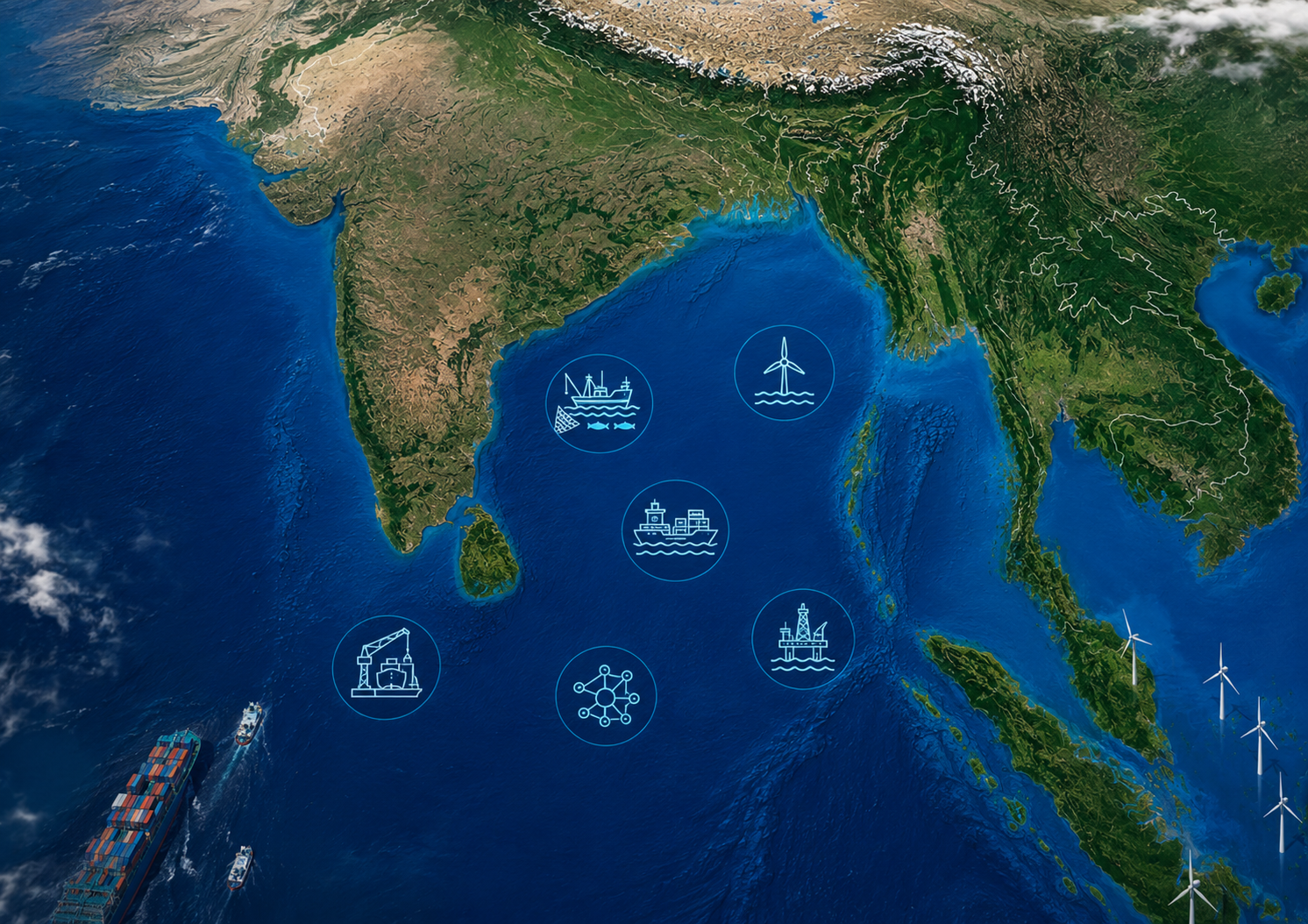
In this era of globalization, one of the global commons, i.e., the maritime arenas, has become increasingly significant. The Bay of Bengal connects Bangladesh, India, Myanmar, Sri Lanka, and Thailand. It is strategically important for a number of countries, as 70-80 percent of China’s energy imports and almost 90 percent of Japan’s and South Korea’s imports all flow through the Strait of Malacca, the southern end of the strait [1]. Historically, it has served as a vital conduit for linking coastal societies and ancient civilizations. In the contemporary period, countries depend on it for trade, fisheries, and maritime security. “While the Bay of Bengal is located at the fulcrum of the Indo-Pacific, between the Indian subcontinent and Southeast Asia, it continues to act more as a divider than a link between land and maritime neighbours”[2].
One major issue plaguing the region is its low level of integration with the forces of globalization. “Even though the region is home to 1.7 billion people, almost one quarter of the world’s population of 7.5 billion, it typically accounts for 2 percent or less of world trade” [3]. On the brighter side, new opportunities are opening up to integrate the region, driven by a more assertive and growth-oriented India and growing contentions against an expansionist China.
The most visible reorientation of policy was demonstrated in the formation of the Bay of Bengal Initiative for Multi-Sectoral Technical and Economic Cooperation (BIMSTEC) in 1997. BIMSTEC was conceived to act as a bridge between the two geoeconomic poles of South and Southeast Asia. BIMSTEC states act as major producers of some of the world’s leading products, such as the garment industry in Bangladesh, consumer appliances in Thailand, etc. “Intra-BIMSEC trade of 6.7 percent in 2023 has translated into a regional trade of US US$ 53.49 billion, up from US $46 billion in 2019, thereby indicating growing trade complementarities among the member states”[4].
In addition to trade and economic cooperation, the member states intend to collaborate on various other areas. For example, at the 4th BIMSTEC Summit held in 2018, a variety of issues were brought up for negotiations, which included combating terror activities, regional connectivity, creating institutional arrangements for regional cooperation and promoting trade and investment amongst member states [5]. A major policy issue that was taken up was the signing of an MoU among the member states to establish the BIMSTEC Grid Interconnection.It also expressed concerns about the issue of climate change, thereby indicating a push towards regional cooperation to address the adverse impact of climate change on local economic and governance structures. Despite being relatively dormant since its inception, the 4th Summit has reinvigorated its base and provided a tangible basis and objectives for furthering cooperation in a variety of domains.
Building on regional cooperation in the region, the concept of the blue economy has become significant. Marine resources such as hilsa fisheries, most prevalent in India and Bangladesh, and coastal shipping routes are often shared among multiple countries, making effective coordination essential. For instance, the Bay of Bengal has been subject to indiscriminate fishing practices ever since the industrialization of the fishing industry with the introduction of mechanized trawlers in the 1960s. Intensive shrimp aquaculture is the most prevalent and dominant form of aquaculture in the region. While it can generate profit margins, it could significantly alter the marine ecology without proper regulations, leading to the depletion of fish stocks and disruption of local ecosystems. One of the major initiatives to deal with this problem has been the Bay of Bengal Large Marine Ecosystem (BOBLME), which is a joint effort of a plethora of countries in the Bay of Bengal. To its credit, the BOBLME project adopted a macro approach to manage the Bay. This involved the application of the Ecosystem Approach to Fisheries Management (EAFM), which promotes the sustainable use of the ecosystem [6]. Moreover, the 30 by 30 target, which is a global initiative to protect 30 percent of the world’s land and oceans by 2030, has also been adopted by various countries in the region, thereby highlighting the capacity for joint conservation efforts to build more sustainable livelihoods and a marine economy.
While the blue economy has provided a broad rules-based framework for the sustainable management of marine resources, what matters is how such frameworks have been operationalized through local governance structures. In Bangladesh, the ECOFISH program, which is characterized by co-management of fisheries by local communities, helps to improve conservation outcomes and income flows for small-scale fishermen. Similarly, in the coastal areas of India, such as in the state of Tamil Nadu, women’s participation in the traditional ‘Panchayat system,’ in which they had been systematically excluded until now, is paving the way for change. Their participation has further led to the emergence of women-led self-help groups (SHGs), which have played a significant role in fish drying, processing, etc. These groups have been supported by various government initiatives such as the Tamil Nadu State Rural Livelihoods Mission through training and microcredit access. These models showcase how the concept of the blue economy could be implemented on the ground, thereby contributing to a more inclusive and resilient Bay of Bengal.
Looking ahead, the Bay of Bengal has the capacity to transform itself from a fragmented maritime space into a cohesive hub of regional integration. However, such a transformation requires sustained efforts from all the actors in the region and a particular emphasis on promoting sustainable and inclusive policies so that the benefits of progress can be evenly distributed among communities, ensuring that economic growth does not exacerbate existing inequalities. Ultimately, the future of the region depends on how overarching policies could be adopted into local governance structures, ensuring that they align with the needs and priorities of local communities to foster effective implementation and engagement.
Endnotes
1. Frost, E. L. (2017). Its Time To Deepen Integration Around The Bay Of Bengal.
2. Xavier, C., & Palit, A. (2023). Connectivity and cooperation in the Bay of Bengal region.Centre for Social and Economic Progress
3. Frost, E. L. (2017). Its Time To Deepen Integration Around The Bay Of Bengal.
4. De, P., Centre for Maritime Economy and Connectivity, & BIMSTEC Secretariat. (2024). Accelerating regional
cooperation in BIMSTEC. CMEC Policy Brief.
5. Palit, A., Choudhury, R., & Tieri, S. (2018). BIMSTEC: Relevance and Challenges. Institute of South Asian Studies.
6. Savio Lobbo, A. (2023b, February 21). Lessons from the Hilsa: An Aquascape Approach to the Sustainable
Management of Blue Foods and Threatened Aquatic Species in the Bay of Bengal.CSEP – Centre for Social
and Economic Progress.
Sagnik Nandi is a student of MA Political Science and International Relations 2025-2027, at Jadavpur University, Kolkata and a Research Intern at IDDF Research Foundation