IDDF Research Foundation Hosts Distinguished Lecture on “Iran’s Grand Strategy” by Professor Vali Reza Nasr

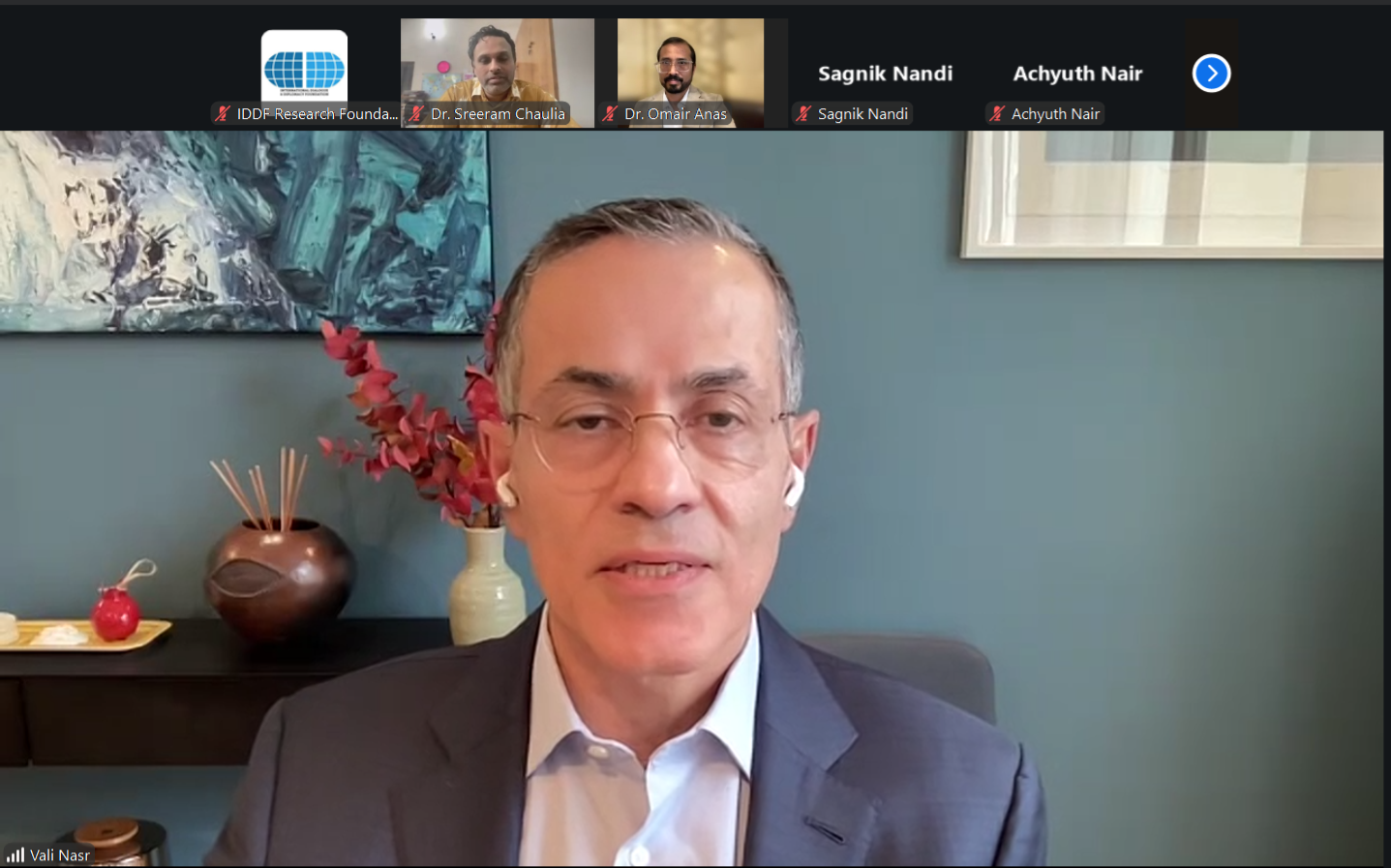
The IDDF Research Foundation recently organised a highly insightful Distinguished Lecture featuring Professor Vali Reza Nasr, Majid Khadduri Professor of International Affairs and Middle East Studies at Johns Hopkins University. Held online via Zoom, the lecture offered in-depth insights into Iran’s strategic thinking, regional policies, and historical evolution in the Middle East, drawing upon Professor Nasr’s latest book, Iran’s Grand Strategy: A Political History.
The session was chaired by Dr. Sreeram Chaulia, Professor and Dean of the Jindal School of International Affairs, and moderated by Dr. Omair Anas, Director (Research) at the IDDF Research Foundation. The lecture was followed by an engaging and well-structured moderated question-and-answer session.
Key Highlights from the Lecture
Iran’s Contemporary Challenges
Professor Nasr began by outlining Iran’s current challenges, including heightened regional tensions, internal protests, demographic pressures arising from a large young population, environmental stress, and a weakening economy. This broader context helped frame Iran’s complex domestic and foreign policy dilemmas.
Defining Iran’s Grand Strategy
At the core of Professor Nasr’s argument was the assertion that Iran’s foreign policy is not driven solely by religious ideology. Instead, it is shaped by a long-standing grand strategy rooted in historical experiences of foreign intervention, the pursuit of independence, and resistance to imperial influence. This strategic outlook continues to shape Iran’s behaviour in regional and global affairs.
The Centrality of Independence
Professor Nasr emphasised that for Iran’s revolutionary leadership, particularly Ayatollah Ruhollah Khomeini, political independence was paramount. Khomeini’s belief that all national decisions should be made within Iran reflected deep-seated historical grievances stemming from Iran’s experience of foreign interference during the nineteenth and twentieth centuries. These included British and Russian influence and, most notably, the overthrow of Iran’s elected government in the mid-twentieth century, which left a lasting impact on Iran’s political consciousness.
A State Shaped by Prolonged Conflict
The lecture highlighted that Iran has effectively been in prolonged confrontation with the United States, primarily through economic sanctions and indirect conflict. This sustained pressure has profoundly shaped Iran’s political system, economic structure, and internal power dynamics. Professor Nasr argued that Iran is not merely a state shaped by ideology, but one fundamentally moulded by decades of strategic confrontation.
The Current State of Iran’s Grand Strategy
Concluding his lecture, Professor Nasr observed that recent regional developments have weakened Iran’s strategic depth in parts of the Arab world, leading to more direct confrontations and increased vulnerability. At the same time, prolonged economic strain has exhausted large segments of the Iranian population, contributing to widespread domestic unrest. The central question facing Iran today, he argued, is whether its long-standing grand strategy remains sustainable under current conditions.
Engaging Question-and-Answer Session
The discussion that followed explored several critical dimensions of Iran’s regional role:
Sectarian Dynamics and Saudi–Iran Rivalry
Addressing questions on sectarianism, Professor Nasr explained that while Iran and Saudi Arabia are natural regional rivals, sectarian divisions have often been politically mobilised rather than being the primary driver of rivalry. He noted that sectarianism, though a social reality, has frequently been instrumentalised as part of broader geopolitical competition.
Iran’s Asymmetric Partnerships with Russia and China
In response to questions about Iran’s growing ties with Russia and China, Professor Nasr clarified that Iran’s alignment with these powers stems less from ideology and more from its strategic opposition to US dominance. Iran views these partnerships as providing strategic depth against Western pressure, although he also acknowledged the limitations of these relationships in fully addressing Iran’s security and economic challenges.
The event concluded with the Dr Omair Anas On behalf of IDDF Research Foundation expressing his sincere appreciation to Professor Vali Reza Nasr for his thoughtful analysis and valuable insights into one of the most complex and consequential regions in contemporary international politics.
The lecture attracted wide participation from senior bureaucrats, diplomatic editors, academicians, research scholars, policy professionals, and strategic analysts, reflecting strong interest from the policy and academic community.