India and Türkiye Need a “Functional Reset”, Not a Grand Reconciliation

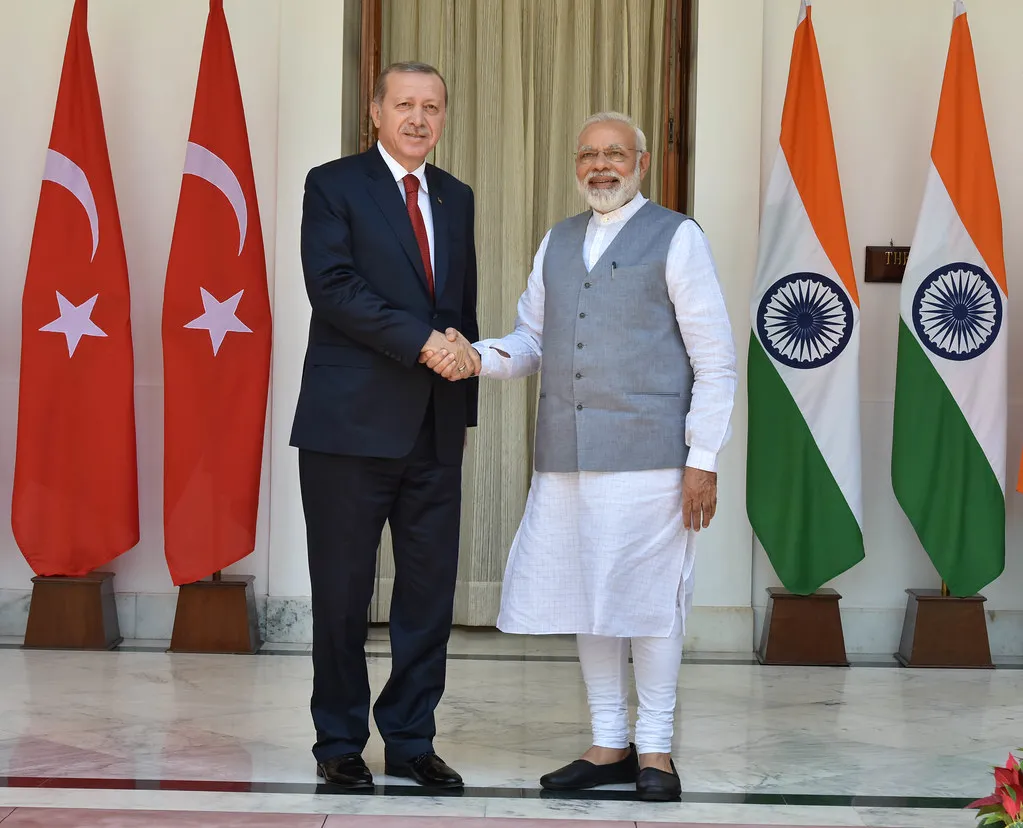
The meeting between the Indian and Turkish officials in New Delhi on 8 April was significant because of its very modest nature. This was an FO consultation since June 2022 but not a strategic move towards reconciliation. But the fact that both issues of trade and technology on one hand and terror on the other hand could be discussed in the same agenda meant that the two countries were trying to test how they would deal with differences without destroying the whole relationship.
For too long, India–Türkiye relations have been discussed in extremes. With every dispute between the two countries comes the prediction that their relationship is irrevocably damaged, while each meeting between diplomats yields premature talk of a strategic alliance. Neither interpretation reflects the underlying reality. India and Türkiye are unlikely to agree on every major political question, but they also have too many economic, geographical and diplomatic interests to benefit from prolonged estrangement.
The objective should therefore not be a grand reconciliation. It should be a functional reset: a relationship in which disagreements are addressed honestly but are not allowed to paralyse cooperation in every other field.
The political problems are very real. Türkiye’s political and defence ties with Pakistan, reinforced by President Erdoğan’s recurring comments on Kashmir, have long generated suspicion among Indian policymakers. The rupture was not caused by rhetoric alone. Ankara’s expressions of solidarity with Islamabad, together with Indian official claims that Pakistan had used Turkish-origin UAVs during the hostilities, reinforced a perception in New Delhi that Türkiye was no longer merely close to Pakistan but materially aligned with it. Whether Ankara accepts that interpretation is secondary; any reset must begin by acknowledging that the perception exists.
Ankara should not underestimate how closely India connects the Pakistan issue with terrorism and national security. What may be presented in Türkiye as diplomatic solidarity with a traditional partner can be interpreted in India as support for policies directed against Indian security interests.
At the same time, expecting Türkiye to abandon its long-standing relationship with Pakistan is not a viable basis for diplomacy. India is entitled to insist that its security concerns be treated seriously, but policy must begin with the world as it exists rather than with the world each side would prefer. The relevant question is not whether India and Türkiye can eliminate every disagreement. It is whether they can prevent those disagreements from consuming the entire relationship.
The economic figures suggest that disengagement would serve neither country. The total bilateral trade was around $7.5 billion in the year 2025. Trade gives both countries a reason to deal with political tension. The relationship is commercially asymmetric, with India enjoying a substantial surplus.
Investment, however, remains far below the potential of two G20 economies. Turkish direct investment stock in India stood at only $144 million in 2024, while Indian direct investment stock in Türkiye was around $280 million. The institutional infrastructure is equally underused. The Türkiye–India Joint Committee on Economic and Technical Cooperation has not met since 2014, while the last joint meeting between the Türkiye–India Business Council and its Indian counterpart took place in 2011.
These dormant mechanisms offer an obvious place to begin. The two governments should reconvene the joint economic committee and establish a three-year commercial action plan.
Türkiye offers access to European, Mediterranean, Black Sea and Central Asian commercial networks, together with considerable experience in flexible manufacturing, contracting, logistics and industrial clustering. Connectivity offers another potential area for limited cooperation. Officials and businesses, therefore, should examine practical areas such as freight forwarding, customs digitalisation, port services and the participation of Turkish logistics companies in India-linked supply chains.
Disaster relief provides an even stronger foundation. As it is both practical and politically less contentious. Following the devastating Kahramanmaras earthquakes in 2023, India launched Operation Dost, deploying search-and-rescue teams, a field hospital and relief supplies to Türkiye. Turkish officials subsequently expressed their gratitude for India’s rapid assistance.
That episode should not remain a one-off act of humanitarian assistance. Both India and Türkiye are highly exposed to earthquakes and other natural disasters. NDRF and AFAD should hold an annual tabletop exercise, followed by a joint urban search and rescue drill. Universities specialising in earthquake engineering could support these exercises with a parallel technical workshop on resilient construction.
There must also be diplomatic guardrails. Foreign Office Consultations should take place annually, even when relations deteriorate. The two governments should also establish a senior-official emergency channel, allowing them to communicate directly rather than through press releases and media speculation. Differences will inevitably be expressed, but both governments should distinguish between articulating a position and using every bilateral forum for punitive purposes.
Ankara has to understand that its relationship with India will depend, among other things, on how Türkiye positions itself on Pakistan-related security issues and cross-border terrorism. India, for its part, should assess Turkish actions individually rather than treating every Türkiye–Pakistan interaction as evidence of an anti-Indian agenda. .
India and Türkiye are major, strategically independent countries with ambitions in the region. The two parties would sometimes compete, occasionally clash and frequently view regional crises from different perspectives. But both have an interest in diversified trade, resilient supply chains, effective disaster response and diplomatic channels that remain open during periods of political tension.
The April 2026 consultations created a narrow opening. The two governments should use it carefully, beginning with achievable projects rather than exaggerated declarations. Success should be measured not by another announcement of a “new era,” but by whether economic institutions meet regularly, businesses encounter fewer obstacles, disaster agencies train together and political crises are prevented from closing every channel of dialogue.
A functional reset is not reconciliation by another name. It is a protocol for preventing one unavoidable disagreement from becoming total bilateral disengagement.
The views and opinions expressed in this article are those of the author(s) and do not necessarily reflect the official policy or position of the International Dialogue & Diplomacy Foundation (IDDF).