The TRIPP Challenge to Iran’s Regional Strategy

By – Rahana Sherin K V
The “Trump Route for International Peace and Prosperity” (TRIPP) has cast a long, disquieting shadow over Iran, which views this initiative not as a bridge to peace, but as a direct challenge to its very existence and influence in the South Caucasus.
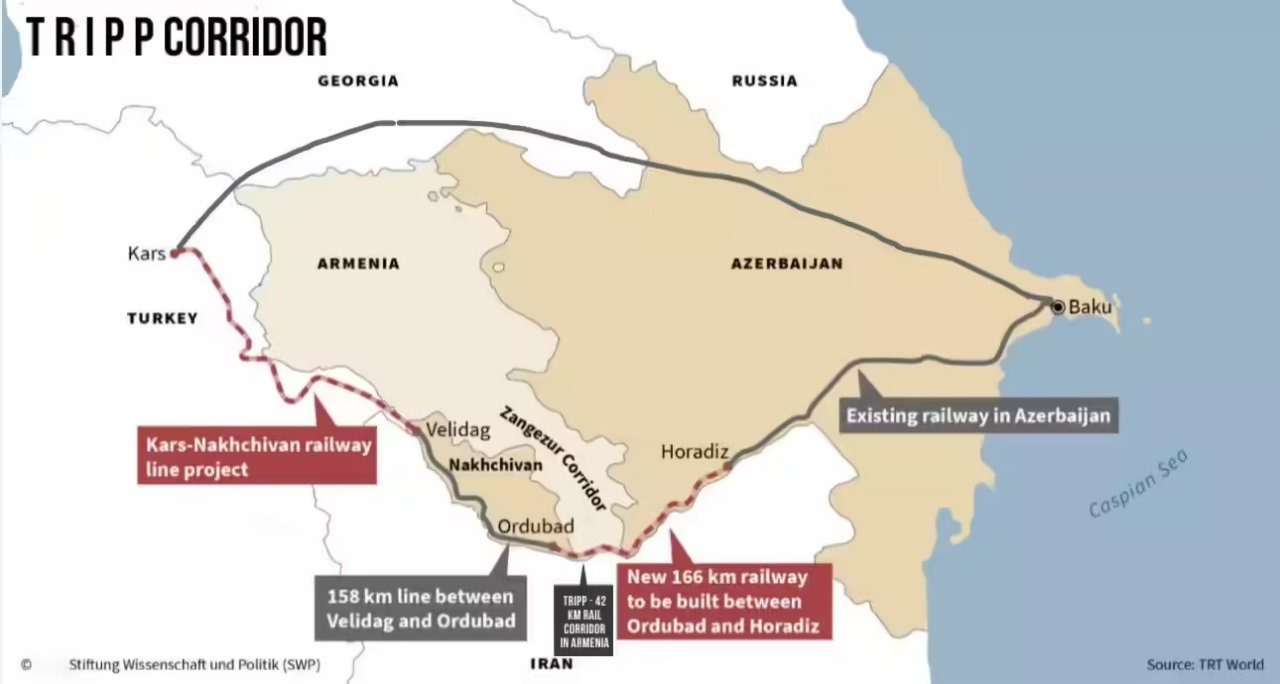
This new corridor, brokered by the United States, takes shape through southern Armenia. Its purpose is to link Azerbaijan’s exclave of Nakhchivan with its homeland. Iran sees it as the construction of a new, contemporary “Silk Road” that purposefully skirts its borders, making it feel excluded and omitted. The thought of America holding development rights and leasing this land for up to 99 years feels like a hostile power establishing a long-term presence right on its northern doorstep.
Iran’s initial reaction was a quiet, veiled caution against “foreign involvement” near its borders, even as it welcomed the broader peace between Armenia and Azerbaijan. But this quickly escalated into a roar of explicit condemnation from its high-ranking officials. Ali Akbar Velayati, a senior adviser, minced no words, declaring Iran would block the initiative “with or without Russia” and branding the US-brokered plan as “political treachery”. cThis strong rhetoric demonstrates Iran’s long-standing concern that the corridor poses a direct threat to its security and territorial integrity in addition to being an economic diversion. The most concerning idea is that NATO might be able to position itself “like a viper”—a strategic wedge slithering between Iran and its longtime ally, Russia—along this route, especially with an American presence.
The economic implications weigh heavily on Iran’s heart. Iran’s territory or sphere of influence has long been traversed by the trade and energy routes that connect Central Asia and Europe. Iran’s position as a major transit hub is now in jeopardy due to a direct route via Armenia, which could deplete vital transit funds from an economy already struggling with international sanctions. It seems like a calculated effort to weaken Iran’s economic clout and general influence in the South Caucasus by marginalising it within an important regional trade network.
What truly makes Iran’s leaders restless is the potential for the corridor to strengthen the bonds between Azerbaijan and Turkey, forming a powerful “Turkic axis” that bypasses Iran. This is a particularly sensitive issue because Iran is home to a significant Azeri minority population. The fear is that a more prosperous and connected Azerbaijan, so closely linked to Turkey, could become a powerful magnet, pulling at the hearts and minds of people in Iran’s northwestern provinces and igniting separatist sentiments – a deeply painful and sensitive threat to Iran’s internal cohesion and national unity.
The most immediate and loudest cry of concern from Iran is about the long shadow of US presence and influence associated with the TRIPP. Despite reassurances that no US military forces will be deployed, the 99-year lease feels to Tehran like a long-term strategic foothold for a hostile power right on its northern border. It is seen as an existential threat because of the perceived restriction caused by a US-backed corridor so near its border. Iran is willing to take extreme measures to impede the corridor’s operations or even stop it from being completed, possibly by aiding non-state actors or sabotaging it. This is demonstrated by its strong warning that the corridor could turn into a “graveyard for Trump’s mercenaries.” Iran remembers its past, how it has used clever, unconventional tactics and supported allies to advance its geopolitical objectives, and such actions, if undertaken, could ignite instability and confrontation in an already volatile region.
The image of NATO coiling “like a viper” echoes Iran’s long-standing concerns about Western expansion into its traditional spheres of influence. Tehran views this as more than just a commercial agreement, but as a component of a broader US strategy to contain and exert pressure on Iran. This ingrained conviction compels Iran to continually reconsider its defences, directing its valuable resources and vigilant gaze towards its northern frontiers.
The fact that Russia, Iran’s long-time ally, has been marginalised as the conventional mediator in the Armenia-Azerbaijan dispute is one harsh reality for Iran. Since Russia has always been the reassuring hand, Iran feels more exposed in the South Caucasus and is compelled to look for new means of defending its interests. However, in an odd turn of events, Russia and Iran may become closer as a result of their shared concerns about the TRIPP and US involvement, which could result in more coordination to oppose the US-backed initiative. While a strong ally against this perceived threat is comforting in the moment, it also quietly highlights how much more Iran is beginning to lean on Russia, a relationship with its own intricate dance of power.
The TRIPP has also cast a shadow over Iran’s normally calm relationship with its neighbour, Armenia. Even though Armenia tries to soothe Iran’s worries, its agreement to have an American-operated corridor so close to Iran’s heart creates an undeniable tension. Iran sees Armenia as a vital pathway to Europe, a protective shield against the growing influence of its Turkic neighbours; any hint of Armenia drifting towards Western influence makes Iran’s leaders look on with a suspicious, heavy heart.
Iran weighs its options for the future, which could include working covertly to impede the corridor’s development or relying heavily on Armenia with diplomatic appeals. Iran is aware that America’s commitment may not last forever and that it may be time for Iran to regain its prominence if the US commitment wavers. Iran’s ability to quickly adjust to this new environment will be crucial to its future. Its executives will most likely search for other ways to distribute its goods in an attempt to mitigate the financial impact. A critical decision must be made on the strategic front: go straight ahead and risk a more serious conflict, or go in a more cunning and covert manner and strengthen its relationships with allies who share its concerns. Meanwhile, the unsettling thought of unrest bubbling up from within, particularly in its Azeri regions, means Iran must keep a watchful eye, perhaps even tightening its grip to ensure peace at home.
What America refers to as a “Route to Peace” ultimately feels to Iran like a hard blow, an outright attack on its security. It’s a course that could force Iran out of the economic picture, encircle it in a hostile embrace, and upset the delicate power balance that Iran has painstakingly preserved. Tehran’s audacious remarks send a strong message: they will not tolerate this. All of this points to a future where tensions and unease will only rise along Iran’s northern borders.
Rahana Sherin K V is a research scholar from the Academy of International Studies, Jamia Millia Islamia, specialising in West Asia and Africa.